
One house, four worlds: where to eat in Cartagena's Old City
From the fire at Kanibal to the night at SLVJ, a chronicle of eating in the walled city through five centuries of Caribbean cooking.
At six in the evening, Cartagena smells of hot oil and the sea. The breeze moves through the stone streets, bougainvillea sways over the balconies, and on the corners of Getsemaní the first arepas are already sizzling. Eating in the Old City comes with an advantage few places can match: everything is a short walk away. The hard part is choosing. At Casa Salvaje we solved it differently: instead of one restaurant, one colonial house with four worlds, each with its own kitchen, its own music and its own way of spending the evening.
Five centuries around one table
Before the walls, there was an Indigenous village here, Calamarí, on the shore of the bay. Pedro de Heredia founded the city on top of it in 1533 and named it after Cartagena in Spain. It soon became the Crown's great Caribbean port: the gold and silver of the Americas went out across its docks, and nearly everything else came in. For more than two centuries, hundreds of thousands of enslaved Africans came in too, because Cartagena was one of the main slave-trading ports of Spanish America.
The city's cooking was born from that crossing, often a brutal one. Indigenous peoples gave it maize and cassava; Spain brought wheat, olive oil and pork; Africa brought much of its rhythm and the art of frying. In the late nineteenth century came Syrian and Lebanese immigrants, who became traders between Cartagena, the Sinú and the Atrato and left the coast kibbeh, stuffed vine leaves and tahini, now so rooted that many locals think of them as their own.
All of it is still out on the street. The palenqueras, with bowls of fruit balanced on their heads, come from San Basilio de Palenque, the town founded by runaways led by Benkos Biohó and often called the first free town in the Americas; UNESCO proclaimed its cultural space a Masterpiece of the Intangible Heritage of Humanity in 2005.
In Cartagena, eating is also a way of reading history.
I · Midday
Fire from the street
On Colombia's Caribbean coast, fire has always belonged to the street. As evening falls on Plaza de la Trinidad in Getsemaní, the stalls heat their oil for arepas de huevo, a recipe the coast associates with the town of Luruaco and one that brings together Indigenous maize, the egg the Spanish brought and the African tradition of frying. Kanibal takes the same idea to the coals: smoke, patience and a long table.
Kanibal: fire and instinct
Kanibal is the world of fire. Meat over flame, vegetables pulled from the coals and a drink poured without asking. It's the place for an unhurried lunch or a long dinner with friends. Every dish carries its mark: the red glyphs are the house alphabet.
Open Monday to Saturday from 12 noon to 12 midnight, and Sundays from 11 am to 7 pm (until 12 am when Monday is a public holiday). Meet Kanibal.
Order meat over flame and vegetables from the coals, and let the drink arrive on its own.
II · Night
Velvet and champeta
Cartagena's nights have a soundtrack of their own. As the story is usually told, in the 1970s sailors docking in Cartagena and Barranquilla brought records of Congolese soukous and Nigerian highlife; the picós, the towering neighbourhood sound systems, played them at full volume, and champeta was born. The city learned to dance with its whole body, and SLVJ knows it.
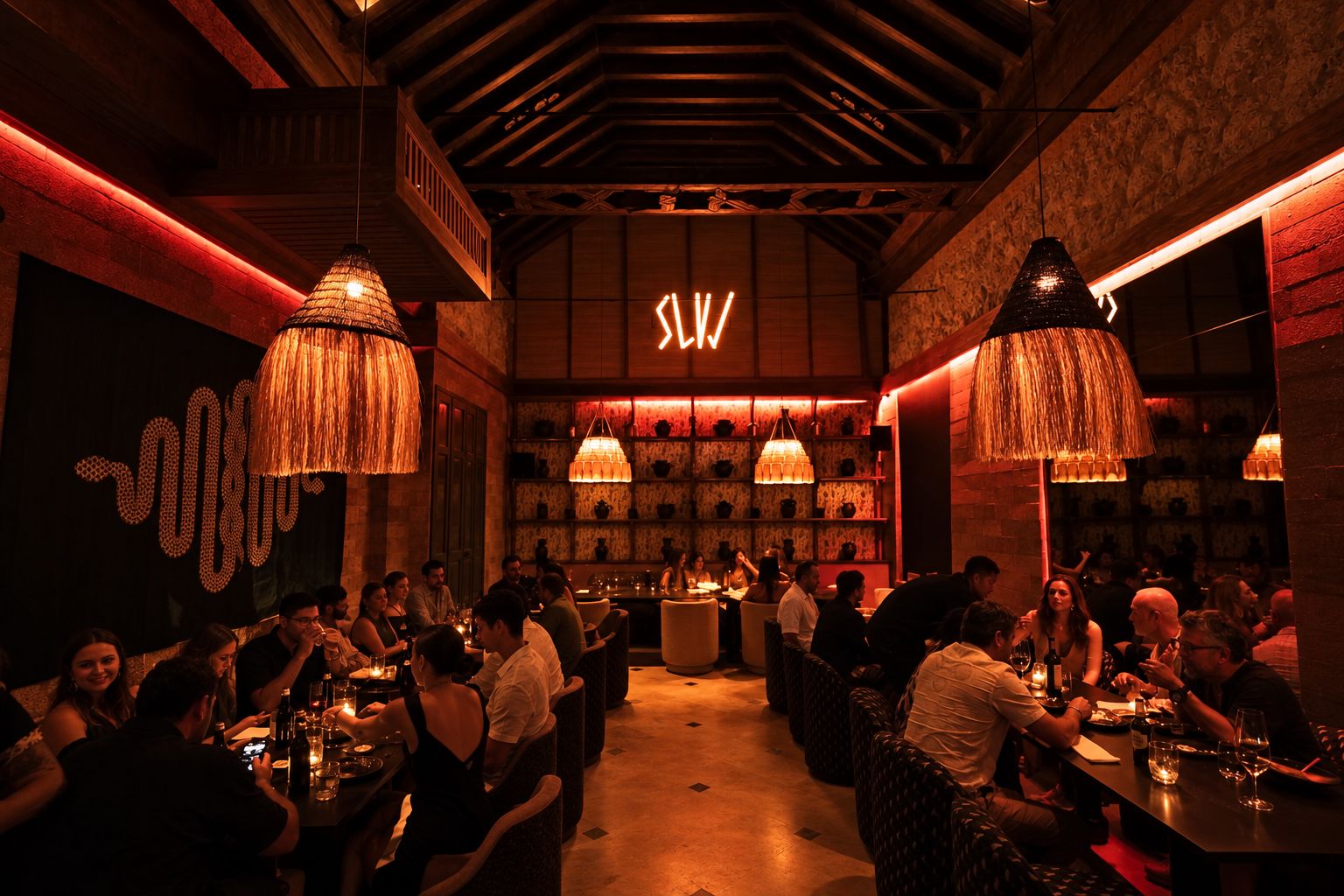
SLVJ: a feast for earthly gods
Stone, velvet, amber light and a sushi bar to open the night. SLVJ is the house's most dressed-up dining room: come for a slow dinner and, Thursday to Saturday, stay as the room turns into a club until 3 am.
Open Monday to Saturday 12–3 pm and 7 pm–12 am, and Sundays 11 am–7 pm (until 12 am when Monday is a public holiday). Meet SLVJ.
Don't miss the sushi bar to open the night, before the room turns into a club.
III · What's next
Daylight and the roll
La Domenica
La Domenica will be the daytime world: coffee when you wake, pizza for a very long lunch and aperitivo as the afternoon fades.
ONO
ONO, the hosomaki bar born in Bogotá, arrives in the house between November and December 2026. To hear first, join the guest list.
IV · House tips
How to eat in the Old City
- Book ahead, especially Thursday to Saturday. Weekend nights fill up; WhatsApp is the fastest way.
- Lunch late. The midday heat calls for a table indoors and a long sobremesa; the city wakes up again when the sun drops.
- Walk. The Old City is made for walking, and the airport is about 15 minutes from our door.
- Leave the night open. At dinner, behave. After dinner, anything.
Epilogue
Before you head home
Save some time for the Portal de los Dulces, beside the Clock Tower. Back when it was still the Portal de los Escribanos, the Scribes' Arcade, Florentino Ariza wrote love letters for hire there in García Márquez's Love in the Time of Cholera. Under the same arches today, glass jars hold cocadas, alegrías made with panela, coconut and millet, and little tamarind balls. There is no sweeter way to say goodbye to the city.
- Kanibal Meet Kanibal · See on the map
- SLVJ Meet SLVJ · See on the map
- La Domenica Meet La Domenica
- ONO Meet ONO · Guest list
Calle Santa Teresa #32-41, where Baloco meets Santa Teresa, two blocks from Plaza Santo Domingo. Every opening time, with each world's live status, is in the hours section.